

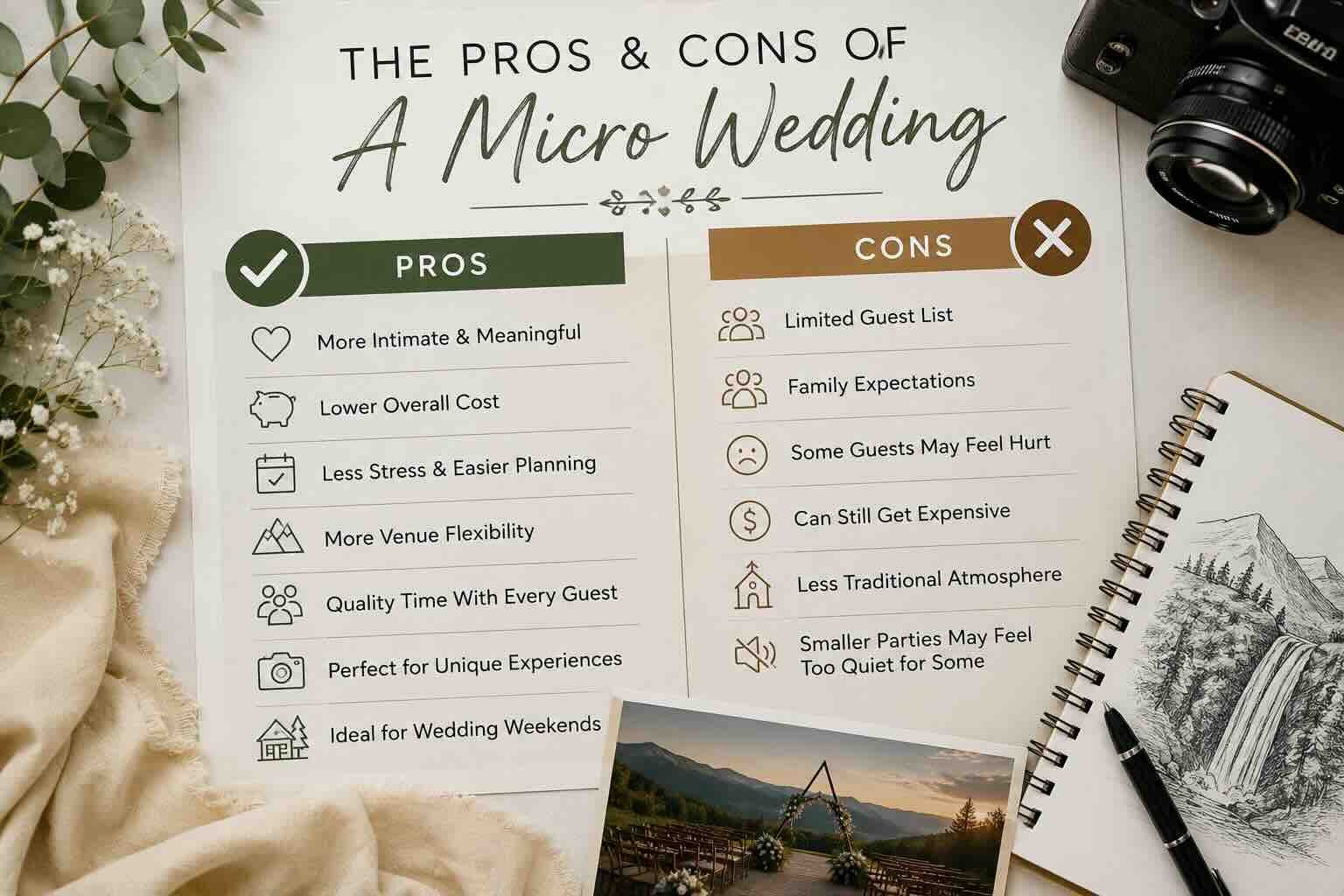
The pros and cons of a micro wedding aren’t really about logistics. They’re about what kind of day you actually want — and whether you’re willing to make the choices that get you there.
Micro weddings have grown in popularity not because they’re trendy, but because a lot of couples have quietly realized that the traditional wedding structure doesn’t fit what they’re after. Fewer guests. A setting that feels like somewhere rather than somewhere rented. A day that moves at a human pace instead of a production schedule.
But smaller isn’t automatically better. And intimate doesn’t mean effortless. Before committing to a micro wedding, it’s worth understanding both what you gain and what you give up — honestly, without the rose-colored framing that tends to surround anything described as “intimate” or “intentional.”
If you’re still working out the budget side of things, our guide to micro wedding cost in North Carolina is a good place to start.
What Is a Micro Wedding, Actually?
A micro wedding is a small wedding — typically somewhere between 10 and 50 guests, though many fall closer to 15 to 30. It still includes the things that make a wedding a wedding: a ceremony, an officiant, photography, usually florals, often a meal or reception of some kind. The difference is scale and intention, not legitimacy.
The word “micro” sometimes makes people nervous, like it implies cutting corners or asking guests to stand in a field with no chairs. It doesn’t. A micro wedding can be incredibly well-appointed. What it doesn’t have is the organizational weight — and cost — of a 150-person event.
The Real Pros of a Micro Wedding
The financial case is real. Fewer guests means lower costs across nearly every category — catering, rentals, staffing, invitations, venue size. That freed-up budget doesn’t have to disappear. Many couples redirect it toward things that actually show up in the experience: better photography, a more distinctive venue, a two-night stay on the property, a dinner that feels like a dinner rather than a banquet service.
But the financial argument, while true, undersells what most couples actually remember. The more lasting advantage of a micro wedding is presence. When there are 20 people in the room instead of 150, the ceremony changes. The couple isn’t performing — they’re participating. There’s no pressure to work the room afterward, no sense of being on display for hours. Guests who are actually there, rather than guests who made the list.
Venue access is another real advantage that doesn’t get talked about enough. Most of the settings that make people stop scrolling — private waterfall properties, forest clearings, mountain creekside ceremony spots — aren’t built for crowds. They’re built for exactly this. A micro wedding opens up locations that simply aren’t available to larger events, and those locations tend to be the ones that create the most distinctive photographs and the most genuinely memorable days.
And then there’s the planning. A micro wedding doesn’t eliminate complexity, but it does reduce it significantly. Fewer vendors to coordinate. Simpler timelines. Less seating chart math. For couples planning from out of state — or couples who just don’t want wedding planning to become a part-time job for 18 months — that reduction in overhead matters.
The Real Cons of a Micro Wedding
The guest list is where most of the difficulty lives. Deciding who makes a list of 20 or 30 people is genuinely hard. Extended family, close friends from different chapters of life, coworkers who have become real relationships — the math doesn’t work for everyone, and some people will notice. That’s not a solvable problem. It’s a tradeoff, and couples who choose micro weddings need to go in clear-eyed about it.
Some people will feel hurt. Most will understand eventually, especially if the couple is consistent and communicates clearly about the format from the start. But the discomfort is real, and it doesn’t always resolve cleanly before the wedding day.
There’s also the assumption that smaller automatically means cheaper — and that’s not always true. A micro wedding can still become expensive if couples choose luxury venues, high-end photography, destination lodging, or premium catering. The budget advantage is flexibility, not a guarantee. Couples who assume a micro wedding will cost a fraction of a traditional one sometimes discover they’ve spent nearly as much, just on different things. Knowing what a micro wedding actually costs in North Carolina before you start planning saves a lot of recalibration later.
And some couples — this is worth saying plainly — genuinely want a big wedding. They want the dance floor packed. They want the extended family gathering that only happens at weddings. They want the energy of a large celebration, and a micro wedding won’t give them that. Smaller is only the right answer if smaller is actually what you want, not just what seems more manageable.
The Emotional Reality Nobody Talks About
Micro weddings are intimate in ways that go beyond guest count. With fewer people present, the emotional intensity of the day concentrates. There’s less ambient noise, less movement, fewer distractions. For most couples, that’s exactly what they were hoping for — they can actually feel what’s happening instead of being swept through it.
But for couples who are uncomfortable with that level of presence, or who are navigating complicated family dynamics, the intimacy can feel like pressure rather than relief. A large wedding has a certain anonymizing effect — things get lost in the activity. A micro wedding doesn’t offer that buffer. Whatever is happening between people is more visible, more felt. That’s worth knowing in advance.
Why Nature-Based Micro Weddings Work So Well
One of the clearest pros and cons of a micro wedding becomes visible when you put it in a natural setting: the smaller the gathering, the more the environment can do. Waterfalls, forest light, mountain air, the sound of a creek — these elements don’t scale well to crowds. They work best when there’s room to actually be inside them rather than pressed against a roped-off viewpoint.
In Western North Carolina, this combination — small guest count, private land, working waterfalls — produces something that’s genuinely hard to replicate. Couples who have spent time at venues like Weddings Over Waterfalls often say the setting itself did most of the emotional work. The ceremony happened inside something rather than in front of it. That distinction matters more than it sounds.
For couples still exploring what’s available, our guide to small wedding venues near Asheville covers a range of options across Western NC.
Micro Weddings and the Wedding Weekend
One thing micro weddings make possible that traditional weddings rarely do: slowing the whole experience down into a weekend rather than compressing it into a single day. When the guest list is small enough, a welcome dinner the night before, the ceremony itself, and a relaxed morning-after brunch become genuinely feasible. Guests stay on or near the property. Time opens up. The wedding becomes something people experience over two or three days rather than five hours.
For couples drawn to this format, how to plan a micro wedding weekend walks through what that actually looks like in practice.
Is a Micro Wedding Right for You?
The pros and cons of a micro wedding ultimately come down to a single honest question: what do you actually want the day to feel like?
If the answer involves presence, a setting that feels real, time with the people who matter most, and a day that moves at its own pace — a micro wedding is probably right. If the answer involves a large celebration, an extended family gathering, a full dance floor, and the energy of a big event — it probably isn’t, and that’s a legitimate choice too.
The couples who are happiest with micro weddings are the ones who chose them on purpose, not because they felt like the easier path. They’re different, not simpler. And for the right couple, that difference is exactly the point.
Planning a Micro Wedding in the North Carolina Mountains?
Weddings Over Waterfalls is a private waterfall venue in Hot Springs, NC designed for intimate weddings, micro weddings, and elopements. Multiple waterfalls, creekside ceremony areas, forest paths, and lodging is booked separately through Windows Over Waterfalls. Both venue-only and all-inclusive packages available.
View wedding pricing or explore our all-inclusive wedding packages.
Not Getting Married Here? You Can Still Experience It
Even if you choose a different venue, you can still experience the waterfalls, forest, and privacy of the property through a stay at Windows Over Waterfalls.
Plan a Romantic Getaway Instead
Airbnb designates this as a top 10% home — their designation, not ours · Guest Favorite · Superhost
What Airbnb Guests Are Saying
★ 4.97
254 Five-Star Reviews
Read the reviews there, then book direct here and skip Airbnb’s guest service fee.
As of October 2026 — and still growing.