

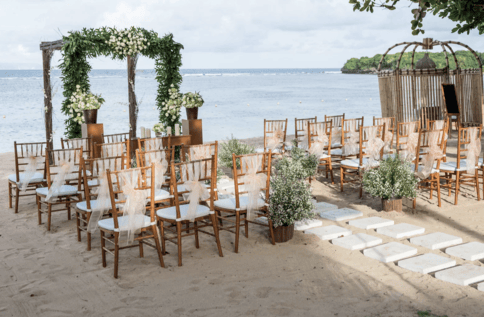
Finding the best beach wedding locations in the US is less about identifying the most photographed coastlines and more about matching a setting to what you actually want the day to feel like. The category is broad — tropical clarity in the Florida Keys is a different experience from the rugged cliffs of Big Sur, which is different again from the quiet barrier islands of the Carolinas or the rocky shores of coastal Maine. “Beach wedding” describes a format, not a character.
This guide works through the key decisions in order: defining what you want, finding venues that fit, understanding the practical considerations specific to coastal settings, and knowing what to look for when you visit.
A ceremony at Windows & Weddings Over Waterfalls, Hot Springs NC
1. Define What You Actually Want
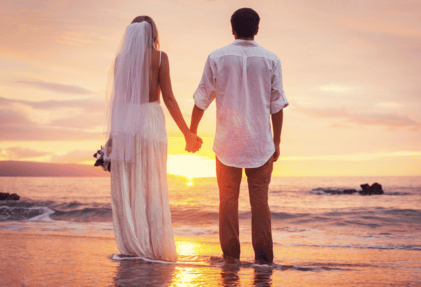
Before comparing specific best beach wedding locations, it helps to work through a few questions that will filter your options faster than any directory.
What kind of atmosphere do you want? Calm and private, or energetic with easy access to restaurants and activities? A secluded cove on Bald Head Island, NC feels completely different from a resort ceremony in Miami Beach — both are beach weddings, but the experience they produce is not the same.
How many guests? The best beach wedding locations for an elopement with a photographer are different from the ones that work for 80 people. Intimate settings that feel right at small scale can feel exposed and disjointed at larger guest counts. Know your number before you fall in love with a venue that can’t support it.
How far will guests travel? A true destination beach wedding — Florida Keys, coastal Maine, the Outer Banks — asks more of guests than a local venue. The tradeoff is usually a more immersive, vacation-like experience. If most of your guests are flying in regardless, a more remote location may not add meaningful friction. If half your list is local, a destination beach wedding requires deliberate communication and planning.
What’s your real budget? High-profile best beach wedding locations — Malibu, Key West, coastal Nantucket — carry pricing that reflects their reputation. Less well-known alternatives in the same regions often provide comparable scenery at significantly lower cost. Understanding what you’re willing to spend before you fall in love with a venue prevents significant frustration later. Our guide to hidden wedding costs is useful context — the venue fee is rarely the complete number.
2. How to Search for the Right Venue
Standard venue directories — The Knot, WeddingWire — are reasonable starting points for finding best beach wedding locations, but they surface the same results for everyone. The more interesting or distinctive venues often don’t advertise heavily through those platforms.
A few more productive approaches:
Search by setting type, not venue type. Instead of “beach wedding venues near Charleston,” search for the specific character you want — private beach ceremony sites, barrier island venues, coastal estate weddings. You’ll find venues that describe themselves by what they are rather than just what they host.
Follow photographers in the region. Wedding photographers who work a coastal area accumulate knowledge of venues that most couples never find through conventional searches. Their Instagram feeds and blog galleries are often a better index of what’s actually available than any directory.
Check local tourism sites. Many coastal regions have tourism boards with wedding-specific pages covering venues, local vendors, and permit requirements. These often surface options that wouldn’t appear in national directories.
Look at private estates and vacation rentals. Some of the best beach wedding locations aren’t listed as wedding venues at all — they’re private beachfront properties that occasionally host small events. Our guide to Airbnb weddings versus private venues covers how that comparison typically works.
Ask a local planner. A planner based in a coastal region will know about off-market options, private properties, and sites that have never been listed anywhere. One conversation can surface options that months of online searching wouldn’t.
3. Public Beach vs. Private Venue

One of the most consequential decisions when choosing among best beach wedding locations is whether you’re looking at a public beach or a private venue. The difference shapes logistics, cost, and the experience on the day itself.
Public beaches are often visually beautiful and cost-effective. They also come with real complications: permits required for events, restrictions on amplified sound, alcohol, and decor, limited or no restroom facilities, no control over who else is on the beach, and no guarantee of the space on the day. Most jurisdictions require permits for ceremonies above a certain guest count — apply early, as processing times vary significantly by municipality.
Private venues — resorts, beach clubs, boutique coastal properties — handle most of the logistics that make public beaches complicated. Permitting, setup, restrooms, vendor coordination, weather contingency — these are typically managed by the venue. The tradeoff is cost and, sometimes, flexibility. Private venues often have vendor requirements, minimum spends, or guest count minimums that may not fit a smaller wedding.
The clearest filter: if you want a small, intimate ceremony with full control over the experience, a private venue almost always produces a better outcome than a public beach, even if the public beach is more visually dramatic.
4. Permits and Regulations
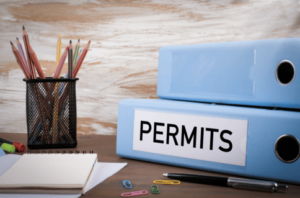
If you’re planning a ceremony on a public beach, permits are not optional — they’re required in most jurisdictions, and the requirements vary considerably by location. Most public beach permits cover the size of your gathering, use of amplified sound, alcohol, temporary structures like arches or tents, and decor restrictions designed to protect wildlife and coastal ecosystems.
Contact the local parks or recreation department directly for the specific requirements at your chosen beach. Don’t assume permit availability — popular beaches in peak season can have limited permit slots, and processing times of 4–8 weeks are common. Apply as early as possible.
Environmental regulations matter too. Many coastal areas prohibit confetti, balloons, and certain types of decor that can harm marine life. Know the rules before you plan decor that turns out to be prohibited.
If navigating this feels like a significant overhead, it’s one of the strongest practical arguments for a private venue — they handle permitting as part of their standard operations, and you inherit that infrastructure rather than managing it yourself.
5. Weather, Tides, and Timing
Timing a ceremony at one of the best beach wedding locations requires working around environmental factors that don’t apply at inland venues.
Tides. High tide can significantly reduce ceremony space and in some cases encroach on setups. Check NOAA’s tide prediction charts for your chosen date and build your ceremony timing around low or stable tide periods. Late afternoon ceremonies — popular for golden hour light — often coincide with tide shifts, so verify the specific timing rather than assuming.
Seasonal weather patterns vary significantly by region. Florida’s Gulf Coast is best in spring before heat and humidity peak; summer brings storms and hurricane season risk runs June through November. Cape Cod and New England peak in late summer and early fall. California beaches are pleasant much of the year but can have significant morning fog in spring and early summer. Research the specific seasonal character of your chosen region before locking in a date.
Hurricane season is a real planning consideration for Gulf Coast and tropical locations. If you’re marrying in Florida, the Caribbean, or the Gulf Coast between June and November, wedding insurance is worth understanding — it covers vendor cancellations, venue closures, and weather-related rescheduling costs. Our guide to wedding insurance covers what those policies typically include.
Every outdoor ceremony needs a real weather contingency. Not a vague “we’ll figure something out” plan — a named backup with specific trigger conditions. Ask your venue coordinator directly: what happens if it rains, what does the backup look like, and does it meaningfully change the experience?
6. Lesser-Known Coastal Locations Worth Considering
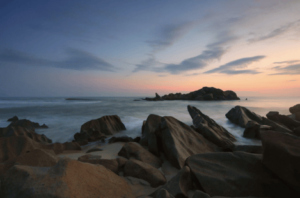
Goose Rocks Beach, ME
Malibu, Key West, and Nantucket are genuinely beautiful. They’re also crowded with couples who had the same idea, priced accordingly, and often less flexible than lesser-known alternatives.
Some coastal locations worth knowing about that don’t always appear on standard lists of best beach wedding locations:
Bald Head Island, NC — accessible only by ferry, no cars on the island, genuinely secluded character. Suited for couples willing to manage the logistics in exchange for real privacy.
Cape May, NJ — Victorian architecture, calm bay beaches, well-developed wedding vendor market. A more intimate and affordable alternative to the Hamptons or Nantucket.
Tybee Island, GA — near Savannah, accessible, quieter than Florida options, with a relaxed coastal character and good vendor infrastructure.
Whidbey Island, WA — ferry-accessible from Seattle, dramatic Pacific Northwest coastal scenery, genuinely off the standard radar for beach weddings.
Goose Rocks Beach, ME — quiet, private feel, stunning in summer, suited for small ceremonies with guests willing to make the trip to coastal Maine.
The common thread: more privacy, lower pricing, and a character that’s specific rather than generic — which tends to produce more memorable ceremonies than the places everyone already knows about.
7. What to Look for on a Site Visit
Photos of best beach wedding locations are marketing. A site visit is information. The gap between the two is often significant — sometimes in your favor, occasionally the reverse.
Walk the property at the time of day your ceremony would happen. See where the light lands, understand the wind situation, assess how the space feels at your guest count rather than the venue’s maximum. Check the path from parking to ceremony space — what guests navigate to reach the site matters, particularly for older guests or anyone with mobility considerations.
Ask the venue coordinator specifically: how does the tide affect the ceremony space at your planned time? What does the weather contingency look like and does it significantly change the experience? What permits does the venue handle, and what falls to you? What’s the vendor access situation?
Our full list of questions to ask your wedding venue covers the complete set — worth reviewing before any site visit or consultation call.
If an in-person visit isn’t possible before booking, request a live video walkthrough at your planned ceremony time rather than a pre-recorded tour. The live version shows you the actual light and sound environment, which photos and edited videos can’t.
If the Mountains Appeal as Much as the Coast
Some couples searching for the best beach wedding locations eventually find that what they’re actually looking for — privacy, natural immersion, an environment that does atmospheric work — is more available in mountain settings than coastal ones, particularly at smaller guest counts and more modest budgets.
Our guide to destination weddings in the mountains covers that decision framework in full. And for couples comparing different types of intimate venue formats, the guide to finding unique wedding destinations in the US covers the broader landscape.
Not Getting Married Here? You Can Still Experience It
Even if you choose a different venue, you can still experience the waterfalls, forest, and privacy of the property through a stay at Windows Over Waterfalls.
Plan a Romantic Getaway Instead
Airbnb designates this as a top 10% home — their designation, not ours · Guest Favorite · Superhost
What Airbnb Guests Are Saying
★ 4.97
243 Five-Star Reviews
243 Reasons to Book With Confidence
As of June 2026 — and still growing.