
Eloping used to mean running off in secret. That’s not what it means anymore. Today, eloping means choosing an intentional, smaller version of getting married — one that prioritizes the experience over the production, the people over the performance, and the moment over the logistics. Most couples who elope don’t do it impulsively. They do it deliberately, because they’ve thought carefully about what actually matters to them.
This guide walks through how to elope — practically, step by step — so you can plan something meaningful without the complexity of a traditional wedding.
Step 1: Decide What Kind of Elopement You Actually Want
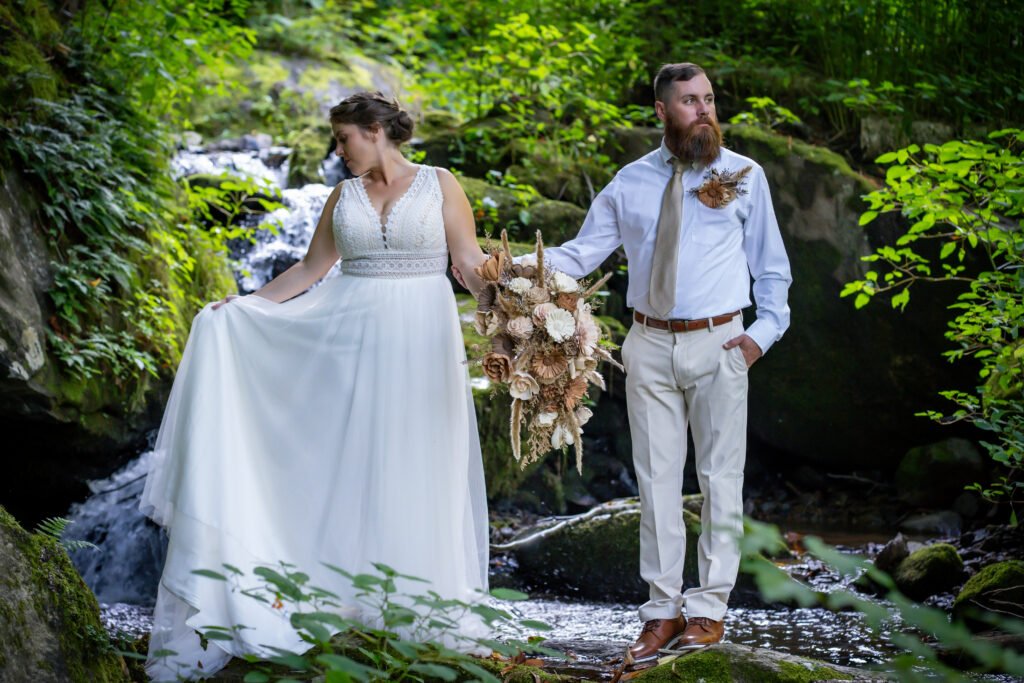
Just one of many ceremony sites – or spot for gorgeous photos
Elopements exist on a spectrum. On one end: just the two of you, an officiant, and a setting that means something. On the other: a small intimate gathering of 10–20 people who matter most, in a location you’ve chosen specifically for what it feels like to be there.
Neither is more valid than the other. The important thing is deciding early which version fits you — because that decision shapes everything else: location, vendors, budget, and timeline.
Questions worth asking before you plan anything:
- Do we want witnesses, or just the two of us?
- How many people, if any, do we want there?
- Do we want a ceremony with an officiant, or something more informal?
- How much of the day do we want documented?
- Do we want to stay somewhere after, or leave the same day?
The answers to these questions are more useful than any checklist when figuring out how to elope in a way that feels right for you.
Step 2: Choose a Location That Does the Work for You
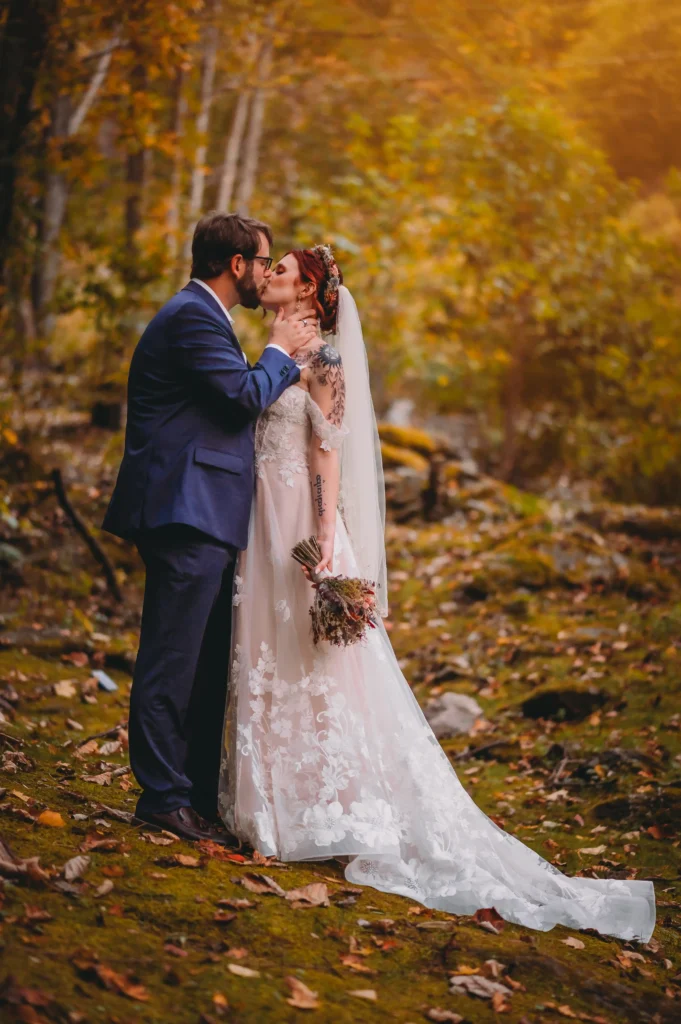
The warmth of a foliage backdrop on our long, mossy pathways
Location is the most important decision in how to elope well. The right setting removes most of the pressure to create atmosphere — because the atmosphere is already there. You’re not decorating a neutral space or manufacturing an environment. You’re stepping into one.
The strongest elopement locations tend to share a few qualities:
- Privacy — no crowds, no strangers, no shared access
- Natural atmosphere — scenery, sound, light that does emotional work on its own
- Flexibility — ceremony spots that feel found rather than staged
- Accessibility — somewhere you can actually get to without logistical heroics
Waterfall settings in particular tend to work exceptionally well for elopements because the sound of moving water changes the emotional pace of the ceremony in ways that no production can replicate. Mountain forest properties with private land give you the immersion without the crowd management of public locations.
If you’re exploring elopement venues near Asheville NC, the Blue Ridge Mountains offer a rare combination of genuine privacy, natural atmosphere, and accessibility from multiple regional airports.
A ceremony at Windows & Weddings Over Waterfalls, Hot Springs NC
Step 3: Understand the Legal Requirements
Getting legally married while eloping is straightforward — but the specifics vary by state and county. Here’s what you generally need to know about how to elope legally:
- Marriage license — required in every US state. Most counties issue them in person at the county clerk’s office. Some states have waiting periods; others don’t. Check the requirements for the state where you’ll be married, not where you live.
- Officiant — someone legally authorized to perform the ceremony must sign the license. This can be a professional officiant, a religious leader, or in some states a friend ordained online. Confirm your officiant is valid in the state where you’re marrying.
- Witnesses — some states require one or two witnesses to sign the marriage license. If you’re eloping with just the two of you, check this in advance.
- Filing — after the ceremony, the signed license needs to be filed with the county clerk. Most officiants handle this automatically — confirm this before your ceremony.
In North Carolina specifically, marriage licenses are issued by the Register of Deeds in the county where you apply. There’s no waiting period, and licenses are valid for 60 days. You can apply in any NC county regardless of where the ceremony takes place.
Step 4: Simplify Your Vendor List
One of the biggest advantages of how to elope versus a traditional wedding is the dramatic reduction in vendor coordination. A traditional wedding might involve 8–12 independent vendors. An elopement typically needs three:
- Officiant — handles the ceremony and legal filing
- Photographer — documents the experience
- Venue — ideally one that already has relationships with both
All-inclusive elopement packages go further — bundling photography, officiant, florals, coordination, and sometimes hair, makeup, and lodging into one experience. For couples eloping from out of state, this is often the most practical approach because it removes the need to vet and coordinate vendors in a place you’ve never been.
The vendors who work best for elopements are those who already know each other and already know the venue. The day moves differently when the team has worked together before.
If you want to compare how all-inclusive packages are structured, our guide to all-inclusive elopement packages covers what to look for.
Step 5: Think About Photography Differently
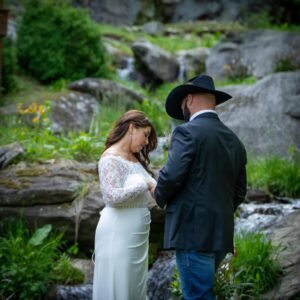
Every bend in the creek is a ceremony waiting to happen
Elopement photography is different from wedding photography — and the best elopement photographers understand that difference. You’re not managing a large group, a complex timeline, or a reception setup. The photographer’s job is to document something intimate and present, often in a location with strong natural light and dramatic scenery.
When choosing a photographer for how to elope well:
- Look for someone who has photographed elopements specifically — not just weddings generally
- Review their portfolio for work in environments similar to where you’ll be marrying
- Have a real conversation about the day — what moments matter to you, how you want it to feel
- Ask whether they prefer documentary style, posed work, or a combination
The best elopement photographers function as both documenter and collaborator. They know the property, understand the light at different times of day, and can guide you through the experience without making it feel managed. At a waterfall venue, a photographer who knows the setting will consistently produce better work than one who’s seeing it for the first time.
Step 6: Make It Personal
One of the clearest advantages of eloping is that nothing about the ceremony needs to be generic. Without the pressure of a large audience or inherited traditions, couples can design a ceremony that actually reflects who they are.
A few things worth considering:
- Write your own vows — or at minimum, talk to your officiant about what you want the ceremony to feel like. The best elopement officiants will work with you beforehand to make it personal rather than formulaic.
- Include something that’s uniquely yours — a reading that matters to you, a ritual connected to your relationship, a detail that has meaning beyond aesthetics
- Don’t over-choreograph it — the most memorable elopements tend to leave room for things to happen naturally rather than running on a tight script
Eloping also removes most of the pressure to perform for a room. You’re present for each other, in a place you’ve chosen, with people you’ve chosen. That’s the entire structure of the day — and it’s more than enough.
Step 7: Address the Common Misconceptions Early
A few things come up repeatedly when couples are figuring out how to elope — mostly from people around them, not from themselves. Worth addressing directly:
Eloping isn’t impulsive. Most couples who elope plan it carefully. The difference is that they’re planning an experience rather than an event — which requires fewer vendors and less production, but no less thought.
Eloping doesn’t mean excluding everyone. Some couples elope with 15–20 people. Others elope privately and host a celebration afterward. Others keep it entirely between themselves. All of these are valid. What matters is that the decision belongs to the couple, not to the expectations around them.
Eloping doesn’t mean sacrificing beauty. A private waterfall ceremony in the Blue Ridge Mountains with professional photography, and flowers in a mountain property is a beautiful, complete wedding experience. The setting often delivers more atmosphere than a ballroom at twice the cost.
Step 8: Handle the Practical Details Early
A few logistics worth addressing before you finalize how to elope:
- Tell the people who need to know — close family and friends who would feel hurt finding out after the fact. You don’t owe anyone an invitation, but a heads-up to the people closest to you tends to go better than a surprise announcement.
- Plan for weather — outdoor elopements are subject to conditions. A venue with both indoor and outdoor options gives you flexibility. Rain at a waterfall venue tends to make the waterfalls more dramatic rather than ruining anything.
- Arrive the day before — settle into the setting before the wedding day. Walk the ceremony location. Let the place become familiar.
- Stay after — don’t book a departure for the same evening. The transition into being married is worth having time for.
- Book early — especially for destination elopements in popular areas like the Blue Ridge Mountains, availability fills quickly.
How to Elope at a Waterfall Venue in North Carolina
If a private mountain waterfall setting matches what you’re looking for, Weddings Over Waterfalls in Hot Springs, NC is worth considering. The private property has multiple waterfalls cascading the full length of the land, moss-covered pathways along both sides of the creek, benches at each waterfall, and ceremony spots on the creekside island and in forest clearings. After the ceremony, couples spend two nights in an on-site cabin with 38 windows, two fire pits, a luxury hot tub, and the sound of moving water through the night.
The elopement venue near Asheville is about an hour from the city and accessible from three regional airports. Venue-only elopements start at $250. All-inclusive elopement packages — which include photography, officiant, florals, coordination, cake, and hair and makeup — start at $3,900.
Most couples planning from out of state find the process simpler than expected. The setting, the team, and the structure are already in place. You choose your date, choose your package, and arrive.
Check availability here or view full pricing and package details.
How to Elope: The Short Version
Decide what kind of experience you want. Choose a location that already has the atmosphere you’re looking for. Handle the legal requirements for the state where you’ll marry. Simplify your vendor list. Find a photographer who knows elopements. Make the ceremony personal. Address the misconceptions early so they don’t become noise. Book early, communicate clearly, and give yourself time to actually be present in the place you’ve chosen.
Eloping well isn’t complicated. It’s just a matter of removing everything that isn’t the point — and being deliberate about what is.
Not Getting Married Here? You Can Still Experience It
Even if you choose a different venue, you can still experience the waterfalls, forest, and privacy of the property through a stay at Windows Over Waterfalls.
Plan a Romantic Getaway Instead
Airbnb designates this as a top 10% home — their designation, not ours · Guest Favorite · Superhost
What Airbnb Guests Are Saying
★ 4.97
254 Five-Star Reviews
Read the reviews there, then book direct here and skip Airbnb’s guest service fee.
As of October 2026 — and still growing.